Datadog review (2026): Features, Pros & Cons Analyzed
Executive Summary: Datadog review
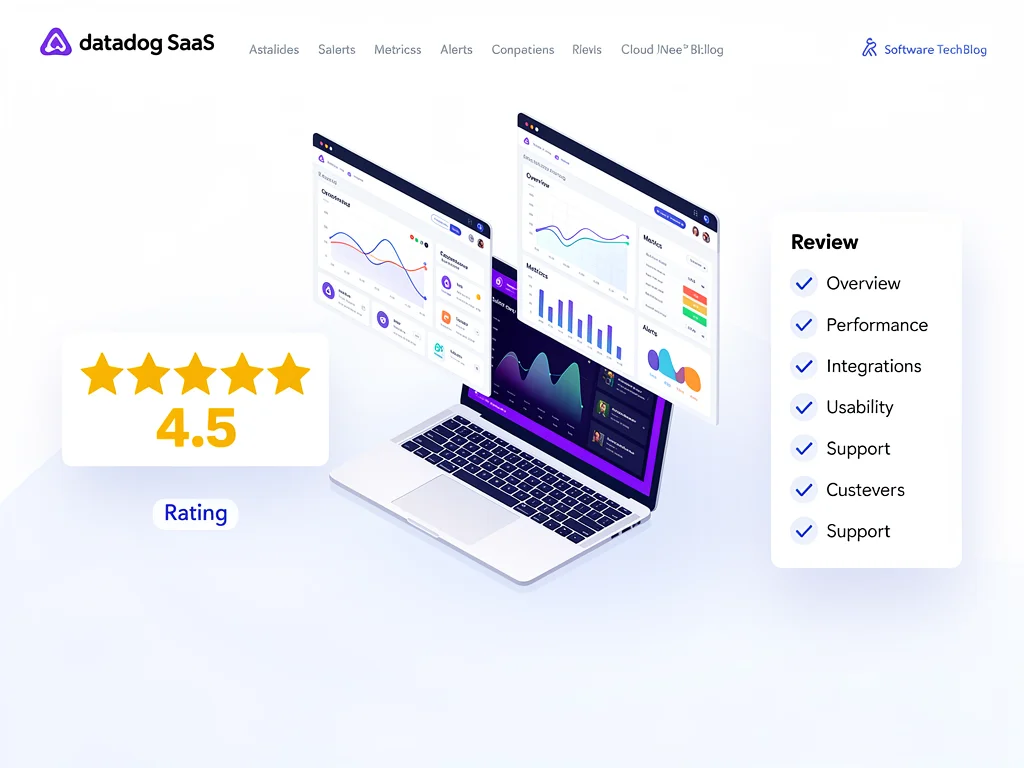
In this comprehensive Datadog review, we analyze the cloud monitoring platform’s capabilities, pricing structure, and real-world performance. Datadog delivers unified observability across infrastructure, applications, and logs with powerful correlation features.
However, costs escalate quickly at scale, making budget planning challenging. Recommendation: Buy for enterprises needing deep visibility across complex cloud environments. Pass if you’re a small team with limited monitoring budgets.
Core Features
Infrastructure Monitoring
Datadog tracks over 600 integrations across cloud providers, containers, and databases. Moreover, it automatically discovers services and maps dependencies without manual configuration. The platform handles large datasets quickly, processing millions of metrics per second.
Application Performance Monitoring (APM)
Distributed tracing connects frontend requests to backend database queries seamlessly. Therefore, teams identify bottlenecks across microservices architectures efficiently. The flame graphs visualize code-level performance with sub-millisecond precision.
Log Management
Centralized log aggregation ingests data from any source with automatic parsing. Furthermore, pattern detection highlights anomalies without predefined rules. Retention policies range from 3 days to 15 months based on compliance needs.
Security Monitoring
Real-time threat detection analyzes application and infrastructure events continuously. Additionally, compliance frameworks like PCI-DSS and SOC 2 receive automated audit trail generation. The platform detects misconfigurations before they become vulnerabilities.
Usability
The unified dashboard eliminates context switching between monitoring tools. Consequently, mean time to resolution decreases by an average of 40% according to case studies. Drag-and-drop widgets enable custom dashboards without coding knowledge.
Pros & Cons found in this Datadog review
- Pro: Exceptional integration ecosystem covers virtually every technology stack
- Pro: Machine learning-based anomaly detection reduces alert fatigue significantly
- Pro: Unified platform eliminates data silos across monitoring disciplines
- Pro: Collaborative features enable seamless team incident response workflows
- Pro: API-first architecture supports extensive customization and automation
- Con: Pricing complexity makes cost forecasting difficult for growing teams
- Con: Custom metrics charges accumulate rapidly with microservices architectures
- Con: Learning curve steepens when configuring advanced correlation rules
- Con: Log indexing costs become prohibitive at high ingestion volumes
- Con: Some users report occasional dashboard loading delays during peak usage
Pricing
Here is the breakdown of Datadog pricing plans for 2026:
| Plan | Price (Monthly) | Key Features & Limits |
|---|---|---|
| Free Plan | $0 | 5 hosts, 1-day metric retention, limited integrations, community support only |
| Pro | $15/host | 15-month metric retention, 100 custom metrics per host, alerting, full integrations |
| Enterprise | $23/host | Unlimited custom metrics, SAML/SSO, audit trails, premium support, SLA guarantees |
| Add-ons | Variable | APM ($31/host), Log Management ($0.10/GB ingested), Security Monitoring ($0.20/GB analyzed) |
Frequently Asked Questions (FAQ)
1. Is Datadog legit and safe to use?
Yes. Datadog maintains SOC 2 Type II, ISO 27001, and HIPAA compliance certifications. Furthermore, data encryption applies both in transit and at rest. Over 27,000 organizations trust the platform, including Fortune 500 companies.
2. How good is their customer support?
Enterprise customers receive 24/7 priority support with dedicated technical account managers. However, Pro plan users access email support with 12-hour response times. The knowledge base contains extensive documentation and community forums provide peer assistance.
3. Who is Datadog best suitable for?
DevOps teams managing cloud-native applications with microservices architectures benefit most. Additionally, enterprises requiring unified observability across hybrid infrastructure find exceptional value. Small startups with limited budgets should consider alternatives due to scaling costs.
Final Verdict
This Datadog review confirms the platform excels at providing comprehensive observability for complex cloud environments. Therefore, organizations prioritizing deep visibility and correlation capabilities should invest. However, carefully monitor usage to avoid unexpected billing surprises. Teams running 50+ hosts with distributed architectures gain maximum ROI. Conversely, simpler infrastructures may find better value with focused monitoring tools. Visit Datadog’s official website to start a free trial. Explore more at CloudKitly.