JFrog Artifactory vs Docker Hub comparison (2026): Features, Costs & Verdict
Executive Summary
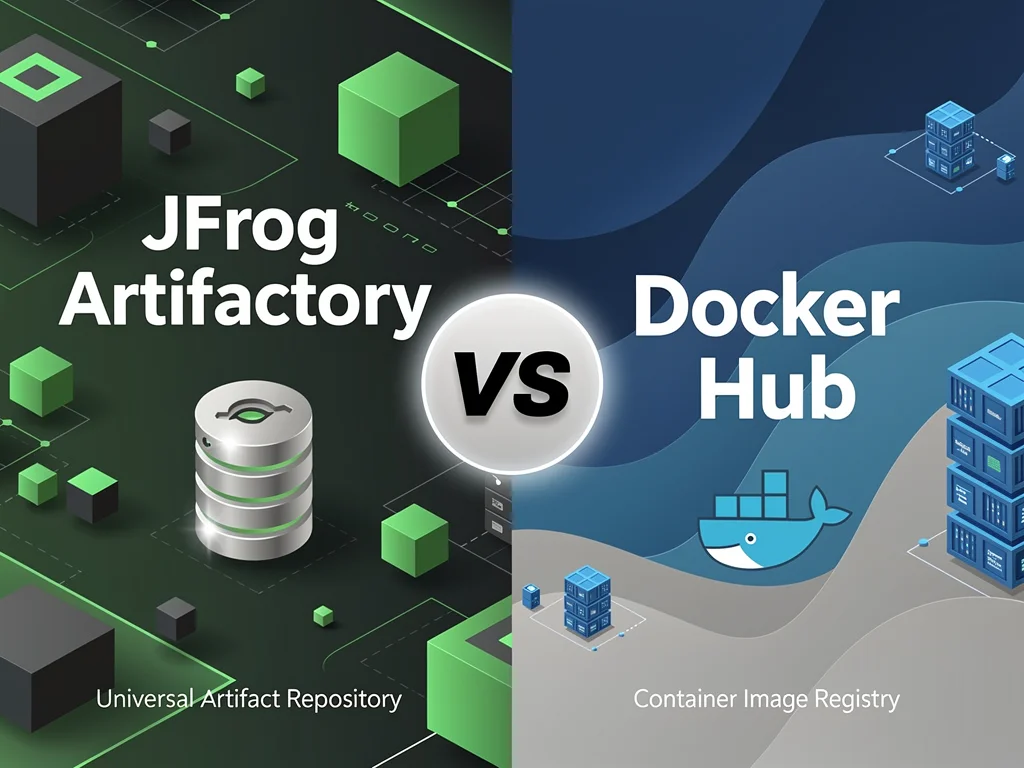
In this detailed JFrog Artifactory vs Docker Hub comparison, we reveal which container registry platform delivers superior value for enterprise teams and solo developers. JFrog Artifactory dominates in multi-format repository management and enterprise security, while Docker Hub excels at simplicity and community-driven workflows.
Therefore, Artifactory wins for DevOps teams managing 50+ microservices across hybrid clouds. However, Docker Hub remains unbeatable for open-source projects and developers needing instant Docker image hosting without complex configuration.
Comparison Table
| Feature | JFrog Artifactory | Docker Hub |
|---|---|---|
| Repository Types | 30+ formats (Docker, Maven, npm, Helm) | Docker images only |
| Free Tier Storage | 2GB (self-hosted unlimited) | Unlimited public repos |
| Security Scanning | JFrog Xray integration (paid) | Snyk integration (limited free scans) |
| Build Automation | Advanced CI/CD pipelines | Automated builds from GitHub |
| Enterprise SSO | SAML, LDAP, OAuth | Team plan only |
| Geo-Replication | Multi-region sync | Not available |
| Starting Price | $98/month (Cloud Pro) | $7/month (Pro) |
Core Features: JFrog Artifactory
JFrog Artifactory functions as a universal artifact repository manager supporting Docker, Kubernetes, Maven, npm, PyPI, and 25+ additional package formats. Consequently, platform engineering teams consolidate all build artifacts into one searchable system instead of juggling separate registries.
Advanced Repository Management
The platform offers local, remote, and virtual repository types. Local repos store proprietary artifacts, while remote repos cache external dependencies from Docker Hub or npmjs.org. Virtual repositories aggregate multiple sources under unified URLs, reducing network latency by ~40% for distributed teams.
Enterprise Security Controls
JFrog Xray integration scans artifacts for CVEs, license violations, and malware before deployment. Moreover, role-based access control (RBAC) restricts repository permissions at granular levels—critical for financial services and healthcare organizations managing compliance audits.
High Availability Architecture
Self-hosted Artifactory deployments support active-active clustering across AWS, Azure, and on-premises data centers. Therefore, Fortune 500 companies achieve 99.99% uptime SLAs with automatic failover during regional outages.
Core Features: Docker Hub
Docker Hub remains the default registry for Docker Engine installations, hosting over 15 million container images. However, its feature set focuses exclusively on Docker workflows rather than polyglot artifact management.
Automated Image Builds
Developers link GitHub or Bitbucket repositories to trigger automatic image builds on every commit. This workflow saves ~5 hours weekly for small teams avoiding manual docker build commands and registry pushes.
Public Repository Ecosystem
The platform hosts official images for nginx, PostgreSQL, Redis, and 100+ verified publishers. Consequently, developers pull production-ready base images without security vetting—reducing container setup time from hours to minutes.
Webhook Integrations
Docker Hub sends HTTP callbacks to CI/CD tools like Jenkins or CircleCI when new image versions publish. Moreover, Slack and Microsoft Teams integrations notify DevOps channels about image updates in real-time.
Price Comparison
Pricing structures at a glance:
- JFrog Artifactory: Free tier (2GB storage, 10GB transfer). Cloud Pro starts at $98/month (50GB storage). Enterprise pricing requires Contact Sales for custom SLAs and geo-replication.
- Docker Hub: Free tier (unlimited public repos, 1 private repo). Pro costs $7/month (unlimited private repos). Team plan at $9/user/month adds SSO and audit logs.
Verdict on Pricing: Docker Hub wins for solo developers and open-source projects. However, Artifactory’s $98/month Cloud Pro plan becomes cost-effective when teams manage 5+ artifact types—eliminating separate subscriptions for npm registries, Maven repositories, and Helm chart museums. Hidden costs include JFrog Xray licensing ($30/month minimum) for vulnerability scanning.
Pros & Cons
JFrog Artifactory Pros & Cons
- Pro: Universal package format support eliminates vendor lock-in across Docker, Kubernetes, and language-specific registries.
- Pro: Self-hosted deployment options satisfy data sovereignty requirements for European GDPR compliance and Chinese cybersecurity laws.
- Pro: Advanced metadata search finds artifacts by build number, Git commit SHA, or custom properties in under 2 seconds.
- Pro: Bandwidth optimization through smart remote repository caching reduces external registry calls by 60-80%.
- Pro: REST API and CLI tools enable infrastructure-as-code workflows with Terraform and Ansible playbooks.
- Con: Steep learning curve—new administrators require 2-3 weeks training to configure repository topologies correctly.
- Con: Cloud Pro plan limits storage to 50GB, forcing upgrades to Enterprise tier ($500+/month) for media-heavy artifacts.
- Con: JFrog Xray security scanning costs extra, unlike Docker Hub’s included Snyk integration.
- Con: UI performance degrades when browsing repositories containing 100,000+ artifacts without pagination filters.
- Con: Self-hosted installations demand dedicated DevOps resources for PostgreSQL database maintenance and backup automation.
Docker Hub Pros & Cons
- Pro: Zero-configuration setup—developers push images within 5 minutes of creating free accounts.
- Pro: Official images from Microsoft, Oracle, and Canonical receive automatic security patches and version updates.
- Pro: GitHub integration triggers automated multi-architecture builds (amd64, arm64) from single Dockerfiles.
- Pro: Free tier provides unlimited bandwidth for public repositories, ideal for open-source distribution.
- Pro: Browser-based image layer inspection shows Dockerfile commands without pulling 2GB images locally.
- Con: Rate limiting restricts anonymous pulls to 100 requests per 6 hours—breaking CI/CD pipelines during traffic spikes.
- Con: No support for Helm charts, Maven JARs, or npm packages forces teams into multi-registry architectures.
- Con: Vulnerability scanning limited to 1 private repository on free tier; Pro plan scans only 5 repos monthly.
- Con: Lack of geo-replication causes 300-500ms latency for Asia-Pacific teams pulling images from US data centers.
- Con: Team plan audit logs retain only 30 days of history—insufficient for SOC 2 compliance requirements.
Frequently Asked Questions (FAQ)
1. Which tool is better for small businesses?
Docker Hub wins for startups with under 10 developers managing Docker-only workflows. The $7/month Pro plan covers most needs. However, businesses using Kubernetes Helm charts or npm packages should choose Artifactory’s free self-hosted tier to avoid juggling multiple registries.
2. Does JFrog Artifactory offer better integration than Docker Hub?
Yes. Artifactory integrates with Jenkins, GitLab CI, Azure DevOps, and 40+ CI/CD platforms through native plugins. Moreover, its REST API supports custom automation scripts. Docker Hub limits integrations to GitHub/Bitbucket automated builds and basic webhooks.
3. Is there a free version available?
Both platforms offer free tiers. Docker Hub provides unlimited public repositories and 1 private repo. Artifactory’s free tier includes 2GB cloud storage or unlimited self-hosted deployment for open-source projects. Therefore, developers can test both without credit cards.
Final Verdict: Winner Revealed
JFrog Artifactory wins for enterprise DevOps teams managing polyglot microservices across AWS, Azure, and on-premises infrastructure. Its universal repository support saves ~15 hours monthly consolidating Maven, npm, and Docker registries into one platform. Consequently, organizations with 50+ services achieve faster artifact resolution and centralized security scanning.
Docker Hub wins for solo developers and open-source maintainers focused exclusively on Docker container distribution. The free tier’s unlimited public repositories and automated GitHub builds eliminate infrastructure overhead. Moreover, the $7/month Pro plan costs 93% less than Artifactory Cloud Pro while delivering sufficient features for teams under 5 developers. Check more reviews at CloudKitly.
![ActiveCampaign vs Leadpages: Ultimate Marketing Tool Showdown [November 2025]](https://cloudkitly.com/wp-content/uploads/2025/11/activecampaign-vs-leadpages-768x768.jpg)